

When a dentist advises against porcelain veneers—or suggests pausing to treat another issue first—it is rarely because they want to talk you out of improving your smile. In most cases, it is because placing thin ceramic shells over teeth that have active gum inflammation, hidden decay, heavy grinding forces, thin enamel or significant crowding puts your long-term oral health at unnecessary risk. A careful clinician looks past short-term appearance to ask whether your natural teeth can support veneers safely for years to come.
Both Healthdirect Australia and Better Health Channel make the clinical priority clear: check the whole mouth thoroughly, treat any disease first, and weigh up conservative options before altering sound enamel. If you are considering porcelain veneers in Fremantle and want an honest explanation of when veneers are not recommended—and what alternatives exist—this guide walks through the clinical reasons dentists pause and how suitability is assessed at On Point Dental Fremantle.
Key takeaway: Porcelain veneers can help address specific front-tooth concerns in suitable candidates, but they involve irreversible enamel removal and ongoing maintenance. A dentist who recommends treating gum disease, managing teeth grinding, or trying whitening, bonding or orthodontics first is working to preserve healthy natural tooth structure.
The core reason dentists pause: irreversible enamel removal
To understand why dentists are selective about recommending porcelain veneers, it helps to look at how traditional veneers are fitted. To stop a porcelain shell looking bulky or creating a ledge that traps plaque at the gumline, the dentist usually trims a thin layer of natural outer enamel from the front face of the tooth. As Better Health Channel notes, this step can be irreversible: enamel does not grow back, so once a tooth is cut for a veneer, it will typically always require a veneer or another protective restoration in future.
That irreversibility creates a lifelong maintenance cycle. The Australian Dental Association (teeth.org.au) reminds patients that having a veneer does not mean no further treatment will ever be needed on that tooth—veneered teeth can still decay, and veneers can chip, fracture or stop matching surrounding natural teeth over time. When a patient has intact, healthy teeth and only a mild cosmetic concern, cutting away healthy enamel may carry more long-term downside than benefit.
Six clinical reasons a dentist may advise against porcelain veneers
During a cosmetic assessment, your dentist examines far more than tooth shade. They evaluate gum stability, X-rays, enamel thickness, jaw muscles and how your upper and lower teeth meet. Below are the six most common clinical reasons a dentist may advise against veneers—or recommend addressing another issue first.
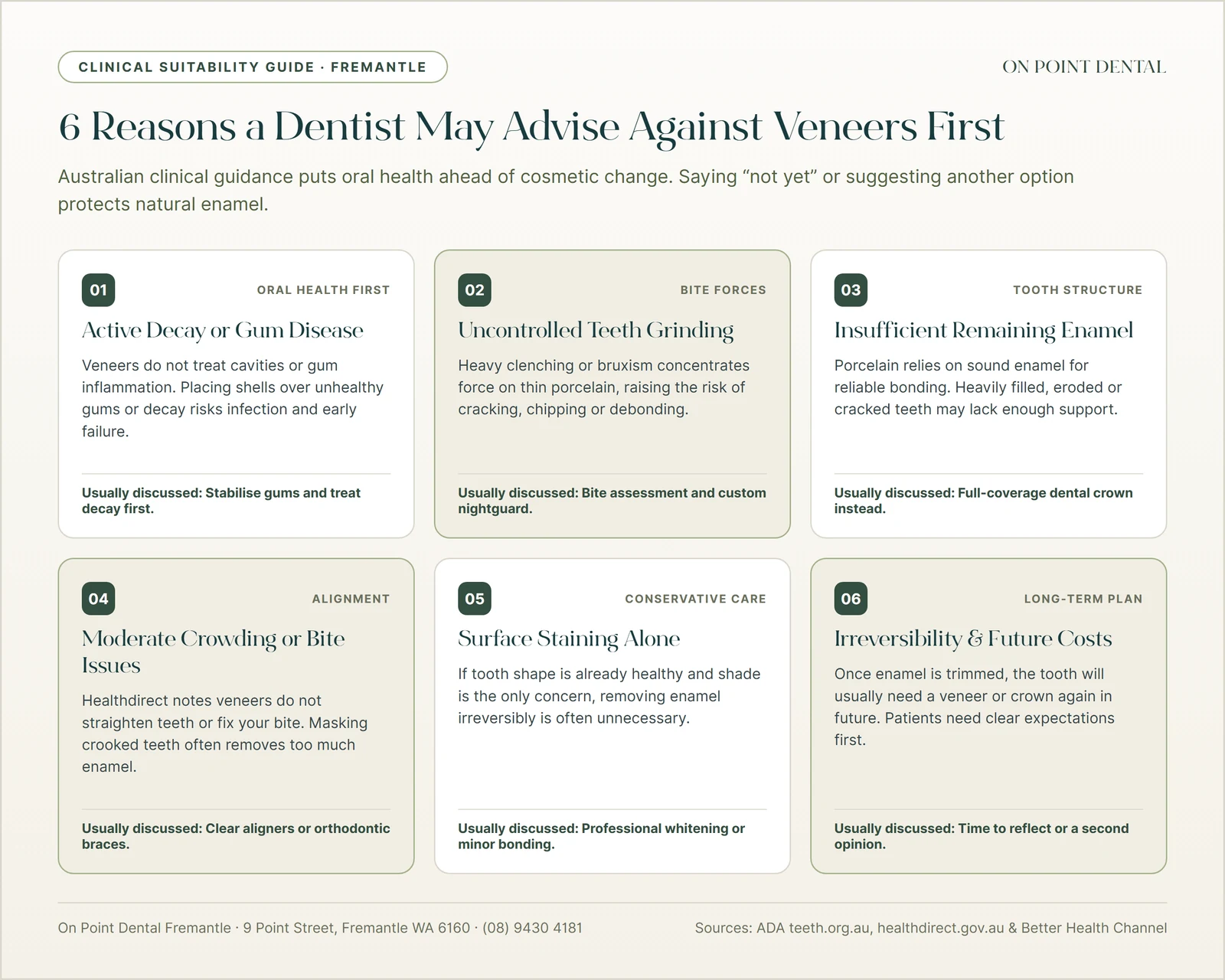
1. Active tooth decay or gum disease
Better Health Channel states that treating oral disease must come before any cosmetic dental procedure. Placing porcelain shells over teeth with untreated cavities allows decay to progress out of sight beneath the ceramic. Similarly, Healthdirect notes that veneers may not be suitable if you have gum disease. Inflamed, bleeding or receding gums make clean bonding difficult, can expose veneer margins prematurely and risk bone loss around the tooth roots. Stabilising periodontal health through gum disease treatment in Fremantle and restoring cavities comes first.
2. Heavy teeth grinding or clenching (bruxism)
Healthdirect specifically flags grinding or clenching as a reason veneers may not be appropriate. Thin porcelain withstands ordinary chewing forces well when properly bonded, yet heavy night-time bruxism or daytime clenching focuses intense sideways shear pressure on front tooth edges. Without addressing bite forces—often involving an assessment for teeth grinding treatment in Fremantle and a custom-fitted protective nightguard—veneers face a higher risk of chipping, cracking or coming loose.
3. Insufficient healthy enamel or heavily weakened teeth
Porcelain veneers bond most predictably to intact outer tooth enamel. If a front tooth has already lost much of its enamel through acid erosion, deep fillings, extensive decay or previous fractures, bonding into exposed underlying dentine is less predictable and a thin front shell will not reinforce the whole tooth. In those situations, Healthdirect and the ADA identify a full-coverage dental crown in Fremantle—which wraps the entire visible tooth—as a more structurally sound option to discuss.
4. Moderate-to-severe crowding, rotation or bite misalignment
Healthdirect makes an important distinction: veneers do not straighten your teeth or correct bite alignment. While veneers can disguise a tiny gap or mild shape irregularity on otherwise aligned teeth, trying to mask noticeably crooked or overlapping teeth with veneers often requires aggressively cutting back protruding enamel, which increases the risk of post-treatment sensitivity or nerve irritation. Moving your own natural teeth with clear aligners or Invisalign in Fremantle or braces addresses the root cause without removing healthy enamel.
5. Surface staining on otherwise well-shaped teeth
If you are happy with the shape, length and alignment of your teeth and only wish to lighten surface discolouration from coffee, tea or ageing, removing enamel for porcelain shells is usually far more invasive than necessary. Discussing professional teeth whitening in Fremantle preserves your intact natural tooth structure, even though whitening is temporary and does not lighten existing fillings or crowns.
6. Practical drawbacks, shade limits and ongoing replacement costs
Even when teeth are clinically healthy, a dentist may recommend pausing if the practical trade-offs do not fit your expectations. Healthdirect lists possible risks including tooth sensitivity after enamel removal, jaw discomfort, cracking or detachment, visible edges if gums recede, fixed veneer colour that cannot be lightened later, and neighbouring natural teeth darkening over time. Understanding that veneers will likely need periodic maintenance and eventual replacement helps you avoid treatment regret.
Conservative alternatives your Fremantle dentist may discuss instead
Saying “veneers aren’t the right first step” does not mean leaving your concerns unaddressed. Healthdirect and Better Health Channel outline several options—starting with doing nothing at all, which is always a valid choice if your teeth are healthy. The visual guide and comparison table below outline how the main alternatives differ in enamel preparation, reversibility and clinical role.
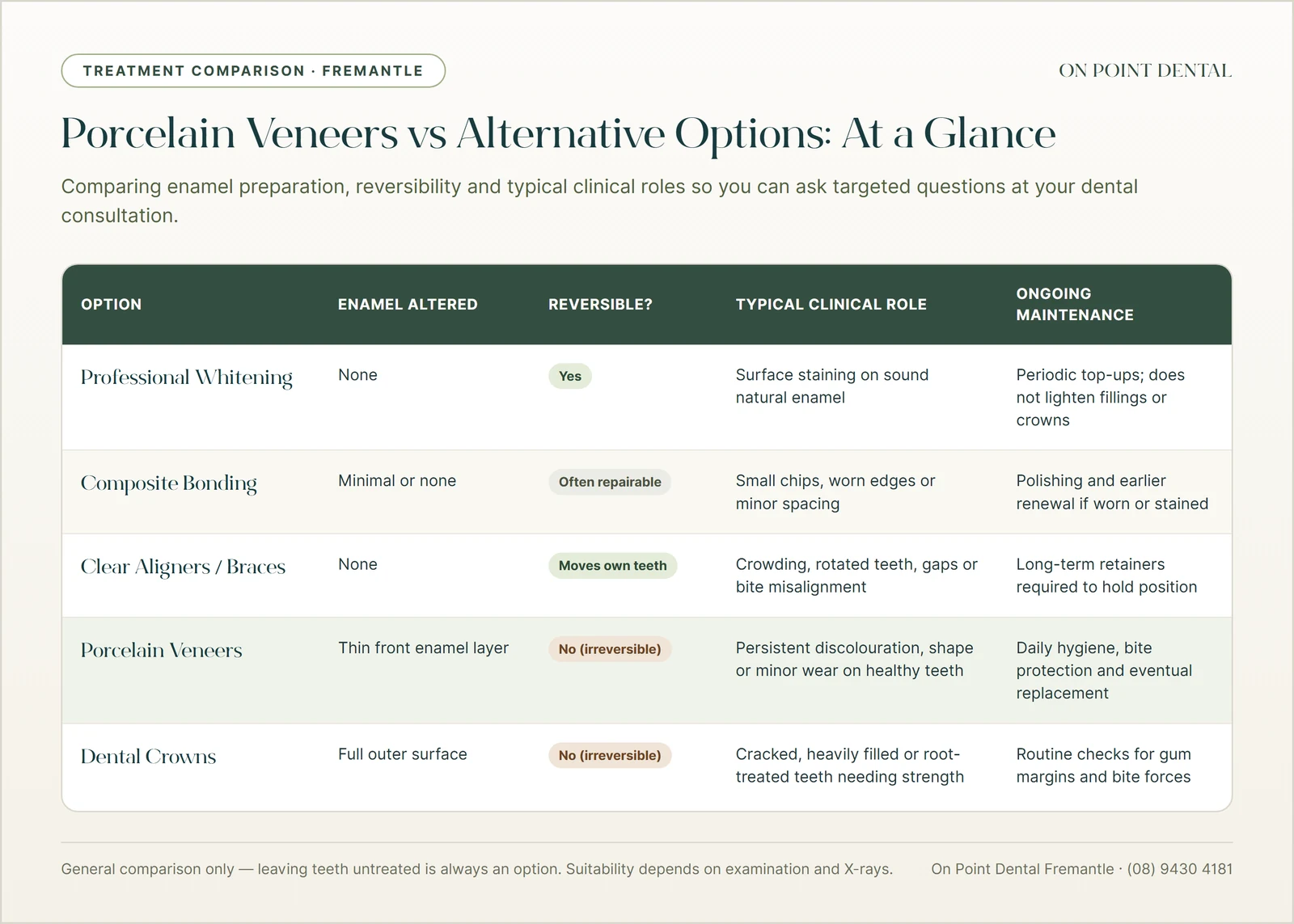
| Option | Typically discussed when... | Enamel preparation | Key limitation to weigh up |
|---|---|---|---|
| Leave teeth as they are | Teeth are healthy and concerns are minor once risks and ongoing costs are explained. | None | Appearance stays unchanged, while natural enamel stays 100% intact. |
| Professional teeth whitening | Surface staining is the main concern on otherwise well-shaped natural teeth. | None | Temporary effect; can cause short-term sensitivity; does not lighten fillings, crowns or veneers. |
| Composite resin bonding | Addressing a small chip, worn edge or minor gap conservatively, often in one visit. | Minimal or none | Shorter working lifespan than porcelain; more prone to staining, dulling or chipping over time. |
| Orthodontics (clear aligners / braces) | Teeth are crowded, rotated, gapped or your bite does not meet evenly. | None | Takes months to complete and requires wearing retainers afterwards to hold tooth position. |
| Porcelain veneers | Front teeth are structurally sound with persistent discolouration, wear or shape concerns that simpler options cannot address. | Thin front enamel layer (irreversible) | Cannot be undone; may chip, detach or need replacement over time; shade cannot be changed once made. |
| Dental crowns | A tooth is cracked, heavily filled, severely worn or has had root canal treatment. | Full outer tooth surface (irreversible) | Removes more tooth structure than a veneer; rare risk of nerve irritation requiring root canal care. |
For localised chips, worn corners or isolated spacing on healthy enamel, many Fremantle patients start by asking about composite bonding in Fremantle. Because adhesive resin is sculpted directly onto selected areas without cutting back the entire front of the tooth, it often preserves natural structure and allows straightforward future adjustments, even though composite resin typically needs polishing or renewal sooner than laboratory porcelain.
What Australian Dental Board rules and health funds mean for your consultation
Much of the debate online about veneer regret comes from overseas clinics promoting rapid, heavily prepared “makeovers” without checking gum health, bite stability or conservative alternatives first. In Australia, three practical safeguards apply to patients considering cosmetic dental work:
- No registered “cosmetic dentist” specialty in Australia: Both the Australian Dental Association and Better Health Channel advise patients that the Dental Board of Australia does not recognise “cosmetic dentist” as a specialist title. Practitioners are registered as general dentists or as dental specialists in recognised fields such as prosthodontics (veneers, crowns and bridges), periodontics (gum health) or orthodontics (tooth and jaw alignment). Checking a clinician’s AHPRA registration and asking whether a specialist referral is helpful for complex bite or gum issues protects your care.
- Restorative vs cosmetic item numbers under Australian health funds: Private health insurance benefits depend heavily on your policy tier and the exact dental item numbers used. As noted across our treatment guides, purely cosmetic procedures are frequently excluded or attract lower rebates than medically necessary restorative care. On Point Dental Fremantle is a preferred provider for HBF and nib, accepts DVA, DHS and other major health funds, and claims eligible visits on the spot through HICAPS. Reviewing our health funds information and requesting a written treatment plan with item numbers lets you check your exact entitlements before deciding.
- Unhurried consent, transparent fees and second opinions: Better Health Channel recommends writing down your goals, asking about pros, cons, costs and complications, and taking time to think before complex procedures. If you wish to compare options across payment structures, our payment plans page outlines Fund My Dental and Zip Pay options (subject to eligibility, approval and terms/account fees). You are always welcome to take your written plan home and seek a second opinion from another registered dentist.
Questions to bring to a consultation at On Point Dental Fremantle
If you are unsure whether porcelain veneers suit your teeth—or a dentist has previously suggested another route—bringing four focused questions helps make your consultation productive:
- “Are my gums, enamel thickness and bite stable enough for veneers, or is there an oral health issue we should treat first?”
- “How much natural enamel would need to be removed on each tooth, and what simpler option would preserve more tooth structure?”
- “If I clench or grind at night, how would that affect veneer longevity and would I need a protective nightguard?”
- “What maintenance and future replacement costs should I plan for over the next 10 to 20 years?”
On Point Dental Fremantle is located at 9 Point Street, Fremantle WA 6160 and is open seven days a week (Monday, Tuesday, Saturday and Sunday 8:00 AM to 10:00 PM; Wednesday and Thursday 8:00 AM to 6:00 PM; Friday 8:00 AM to 7:00 PM), with walk-ins and same-day appointments available where space permits. Bring your health fund card, Medicare card if applicable, and a list of current medications. Phone (08) 9430 4181, read our clinical porcelain veneers Fremantle page, or book a consultation online and specify Fremantle.
Frequently asked questions about veneer suitability and alternatives
Why would a dentist tell me I am not a good candidate for porcelain veneers?
A dentist may advise against porcelain veneers if you have active tooth decay, gum disease, insufficient remaining enamel, heavy untreated teeth grinding or moderate-to-severe crowding or bite misalignment. Australian health guidance from Healthdirect and Better Health Channel emphasises treating underlying oral disease first and matching the procedure to what the tooth actually needs rather than placing thin shells over unstable foundations.
Do porcelain veneers damage healthy teeth?
Preparing a tooth for a traditional porcelain veneer typically requires removing a thin layer of outer enamel so the shell fits flush without bulk. Because natural enamel does not grow back, this alteration is irreversible and can sometimes cause temporary or ongoing sensitivity. When a tooth is already healthy and well shaped, a conservative dentist will discuss whether removing sound enamel is clinically justified compared with non-invasive options.
Can I get porcelain veneers if I grind or clench my teeth?
Healthdirect notes that veneers may not be suitable if you grind or clench your teeth, because excessive biting forces increase the risk of cracking, chipping or debonding thin ceramic shells. A dentist will assess your bite and jaw muscles first; in some cases, managing bruxism with a custom nightguard or choosing a stronger restorative design is discussed before any cosmetic work is considered.
Will porcelain veneers straighten crooked teeth or correct an overbite?
No. Healthdirect clearly states that veneers do not straighten teeth or correct bite alignment. While veneers can mask very minor shape irregularities or small gaps on otherwise straight teeth, attempting to disguise crowded or rotated teeth with veneers often requires removing excessive enamel. Orthodontic treatments such as clear aligners or braces move your natural teeth into alignment without cutting healthy tooth structure.
What are the main alternatives if my dentist advises against veneers?
Depending on your goals and oral health, alternatives listed by Healthdirect and Better Health Channel include leaving your teeth as they are, professional teeth whitening for surface staining, composite resin bonding for small chips or minor gaps, orthodontic treatment with clear aligners or braces for crowding or bite concerns, and dental crowns when teeth are heavily filled, cracked or structurally weakened.
Can I bite into hard foods like apples if I do go ahead with veneers?
Porcelain veneers are designed for normal everyday chewing, but biting directly into very hard foods such as whole crisp apples, ice or hard nuts can place concentrated leverage on thin edges and increase chipping risk. Cutting firm foods into smaller pieces and avoiding habits like nail-biting or opening packaging with your teeth helps protect veneers and bonded restorations.
Should I seek a second opinion before deciding on porcelain veneers in Fremantle?
Yes. Any invasive dental procedure carries risks, and because enamel preparation for porcelain veneers is irreversible, taking time to reflect or seeking a second opinion from another appropriately qualified registered dental practitioner is always encouraged. At On Point Dental Fremantle on 9 Point Street, consultations focus on examining your oral health, explaining all suitable alternatives and giving you clear written information before you decide.
Sources and scope
Sources checked on 25 November 2026. This article provides general patient information only and is not a diagnosis, clinical recommendation or individual treatment plan. Authorship does not indicate a separate clinician review. Any surgical or invasive procedure carries risks; before proceeding, you should seek a second opinion from an appropriately qualified health practitioner, as individual suitability and outcomes vary.
- Healthdirect Australia — Veneers (last reviewed February 2025; checked 25 November 2026): suitability limits (bruxism, gum disease), risks, bite limitations and alternatives.
- Better Health Channel (Victorian Government) — Cosmetic dentistry and teeth whitening (reviewed 12 December 2025; checked 25 November 2026): treating disease first, irreversibility, questions to ask and Australian Dental Board title rules.
- Australian Dental Association (teeth.org.au) — Crowns, bridges and veneers (checked 25 November 2026): porcelain vs composite veneers, ongoing care and prosthodontist referral context.
- On Point Dental — Porcelain veneers in Fremantle, composite bonding, teeth whitening and teeth grinding treatment: verified clinic options, risks and consultation process.
- On Point Dental — Fremantle location and Dr Jeetash Kumar (General Dentist) — clinician profile: verified address, hours, preferred health funds and author credentials.
