
After 20 years, most porcelain veneers have reached or passed the point where a dentist will closely assess them for planned replacement, even if they still look tidy from across the room. Porcelain itself does not decay and resists everyday surface staining well, yet the living tooth beneath it, the gumline around it and the bonding cement holding the shell in place all change gradually over two decades. Understanding those changes early gives you time to plan care calmly rather than reacting to a sudden chip or loose veneer.
Both the Australian Dental Association (teeth.org.au) and Healthdirect Australia emphasise the same long-term reality: having a veneer does not mean a tooth will never require further treatment again. Whether you already have mature veneers that are approaching 15 to 20 years old or you are weighing up porcelain veneers in Floreat for the first time, this guide explains what typically happens over two decades, how to tell when renewal is due, and how our team at On Point Dental Floreat assesses older veneers.
Key takeaway: Porcelain veneers are a long-term option rather than a one-time, maintenance-free fixture. Because traditional preparation removes a thin layer of natural enamel irreversibly, an ageing veneer is usually replaced with a new veneer—or, if the tooth has lost substantial structure, transitioned to a dental crown—rather than left uncovered.
What actually happens to porcelain veneers over 20 years?
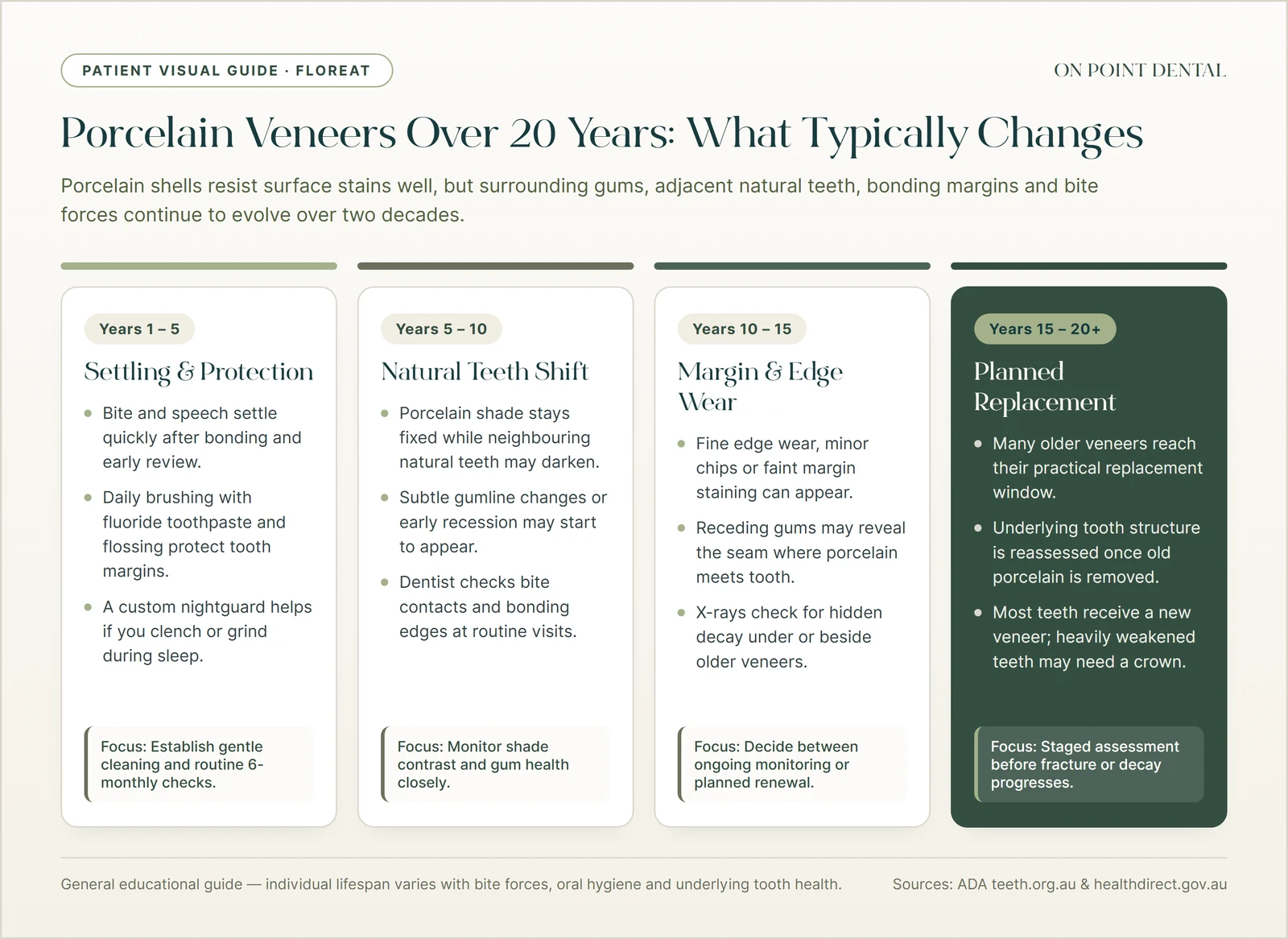
When patients ask what happens after 20 years of veneers, they often picture the ceramic suddenly shattering or turning dark overnight. In everyday dental practice, long-term ageing is usually much more gradual. Four separate parts of the tooth-veneer complex age at different speeds:
- The porcelain shell itself: Laboratory-made dental porcelain holds its colour and lustre well compared with composite resin. Over 10 to 20 years of chewing, temperature changes and occasional hard foods, however, fine edge wear, microscopic surface fatigue or small chips along the biting edge can develop.
- The bonding margin and luting cement: The adhesive seam where porcelain meets natural enamel is thin and carefully sealed at placement. Over many years, everyday chewing forces, dietary acids and normal wear can cause subtle margin roughness or faint staining along the seam.
- The surrounding gums: Even with diligent brushing, gums can recede gradually over decades due to natural ageing, brushing pressure or past gum inflammation. Healthdirect specifically notes that if your gums shrink over time, the upper edges of veneers may become visible near the gumline.
- The natural tooth underneath and neighbouring teeth: As the Australian Dental Association highlights, teeth fitted with veneers can still develop tooth decay at the margins or on the uncovered back surfaces. At the same time, neighbouring natural teeth that do not have veneers gradually darken with age and diet, creating a shade contrast against the fixed colour of older porcelain.
Why veneers are irreversible—and what that means at year 20
Before placing traditional porcelain veneers, a dentist usually trims a thin layer of outer tooth enamel so the ceramic sits flush rather than feeling bulky. As Better Health Channel explains, this preparation can be irreversible: once natural tooth enamel has been cut for a veneer, that tooth will generally always need a veneer or comparable restoration.
At the 15-to-20-year review, this matters for two practical reasons:
- You do not simply peel veneers off and leave bare teeth: Prepared enamel is thinner than untouched enamel and may look dull, feel sensitive to hot and cold drinks, or sit slightly recessed if left uncovered.
- Remaining enamel guides the next restoration: Each time a veneer is removed and replaced, the dentist aims to clean away old porcelain and cement while keeping as much natural tooth structure as possible. If the underlying tooth is healthy and well supported, a fresh porcelain veneer is usually feasible. If decay, large fillings or deeper cracks have developed over the years, your dentist may discuss a full-coverage dental crown in Floreat instead so the whole tooth is reinforced.
Signs your porcelain veneers may need review or replacement
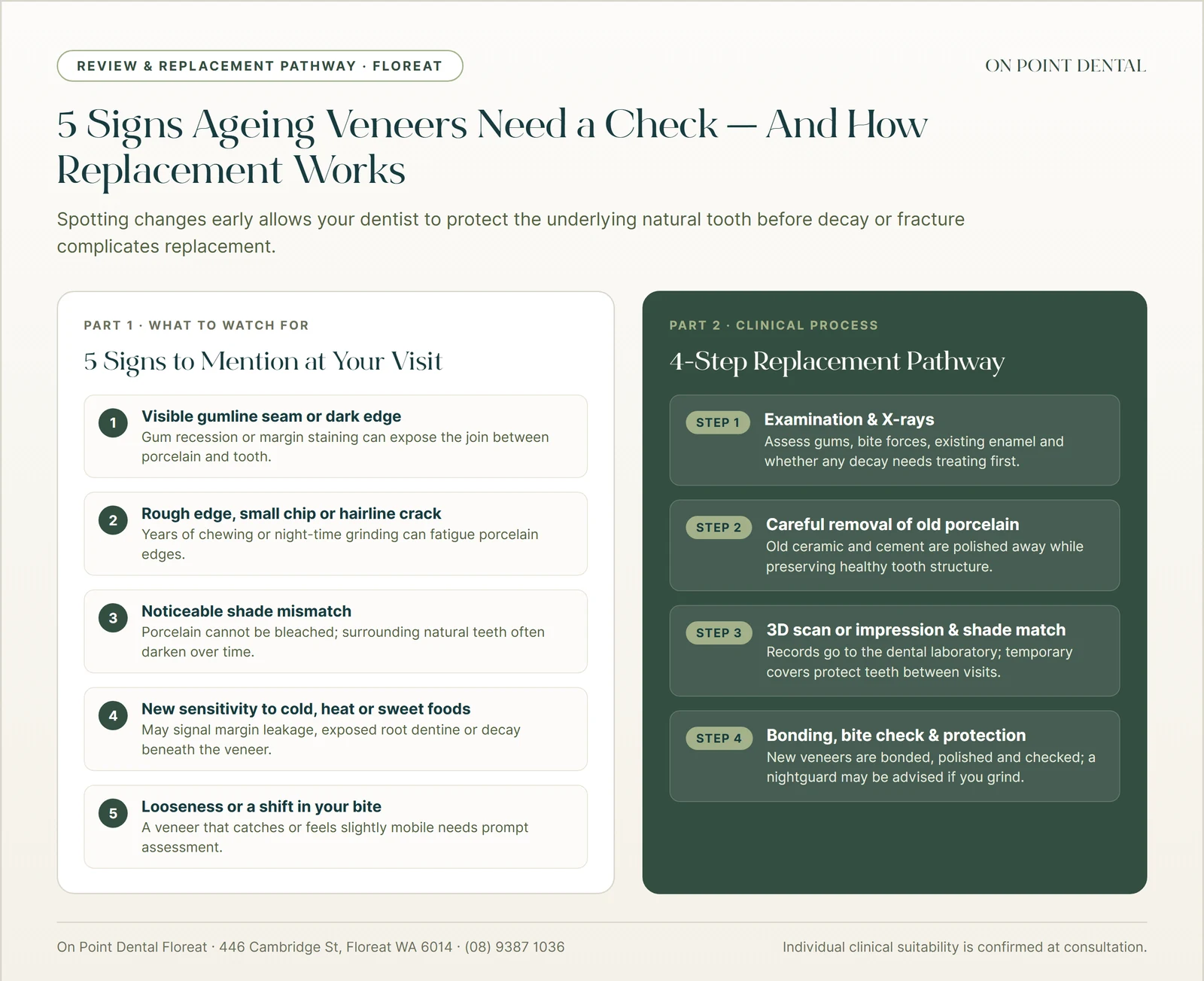
Age alone is only one clue. Some well-cared-for porcelain veneers continue functioning comfortably past 15 years, while others need attention sooner if a patient grinds their teeth at night or experiences gum recession or decay. Watch for these five practical signs and note them down before your next routine dental examination:
- A visible line, step or dark edge at the gumline: Gum recession can uncover the junction where the veneer ends and the natural root begins. Sometimes a faint dark line is harmless staining at an ageing margin, while other times it signals a gap where plaque and bacteria can collect.
- Chips, rough biting edges or hairline cracks: Catching a fingernail or tongue on a chipped corner, or spotting a fine vertical craze line under bright bathroom lighting, warrants a check before a small flaw spreads into a larger fracture.
- Noticeable shade mismatch with adjacent teeth: Because porcelain cannot be bleached with whitening products, surrounding natural teeth often appear yellower after a decade or two. Your dentist can discuss whether teeth whitening in Floreat on the unveneered natural teeth could soften the contrast, or whether renewing the veneers is more practical.
- New or lingering sensitivity to cold, heat or sweet foods: Brief temperature awareness right after placement is different from new sensitivity appearing years later. Late-onset sensitivity can point to exposed root dentine from gum recession, cement breakdown or decay under a margin.
- Looseness, clicking or a change in how your teeth meet: A veneer that feels slightly mobile, catches food along the edge or alters your bite should be assessed promptly so the underlying tooth is protected.
Porcelain veneers vs composite veneers vs crowns at the 10–20 year mark
Patients reviewing older cosmetic dental work often ask how porcelain compares with composite resin veneers or full dental crowns over long time horizons. The comparison table below summarises the main clinical differences grounded in Australian Dental Association, Healthdirect and Better Health Channel guidance.
| Restoration type | Typical long-term wear pattern | Colour stability over time | What happens when replacement is due |
|---|---|---|---|
| Porcelain veneers | Generally lasts longer than composite resin with routine care; edges and cement margins still face gradual wear or gum recession over 10–20+ years. | Non-porous ceramic holds its fabricated shade well; cannot be lightened later, while adjacent natural teeth may darken. | Old porcelain and cement are carefully removed; tooth is scanned or impressed for new laboratory veneers, or assessed for a crown if weakened. |
| Composite resin veneers | Shorter working lifespan than porcelain; more prone to surface dulling, chipping and edge wear under chewing forces. | Can absorb pigments from coffee, tea or red wine over time; periodic polishing helps, though shade shifts sooner than porcelain. | Small chips can often be repaired directly in the chair; worn resin can be stripped back and resurfaced or transitioned to porcelain where suitable. |
| Dental crowns (porcelain or zirconia) | Full-coverage cap surrounding the tooth above the gumline; used when a tooth is cracked, heavily filled or root-treated rather than intact. | Ceramic shade remains stable; gum recession over decades can still expose the crown margin near the root. | Old crown is sectioned and removed, underlying tooth is checked for decay or root issues, and a new custom crown is fitted. |
What happens during a porcelain veneer replacement appointment?
If your Floreat dentist confirms that one or more ageing veneers should be replaced, the process follows a careful, unhurried sequence across at least two clinical visits—very similar to initial laboratory porcelain veneer placement described by the Australian Dental Association and Healthdirect:
- Comprehensive examination and dental X-rays: Your dentist checks gum health, bite alignment, jaw joint comfort and X-rays of the teeth beneath the veneers. Any active decay or gum inflammation is treated first so the foundation is healthy before new ceramic is bonded.
- Careful removal of the existing veneer: Under local anaesthesia where needed for comfort, the dentist gently polishes away the old porcelain shell and residual bonding cement, taking care to preserve healthy natural enamel and dentine underneath.
- 3D digital scan or impression and shade planning: Once the tooth surface is clean and smooth, a 3D digital scan or mould is captured and sent to a dental laboratory technician. Shade, surface texture and translucency are matched carefully to your facial features and surrounding teeth. Temporary coverings protect the prepared teeth while the laboratory crafts the replacements.
- Try-in, bonding and bite adjustment: At the fitting appointment, the temporary veneers are removed, the new porcelain veneers are checked for fit, margin seal and colour before bonding, and your bite is fine-tuned so forces distribute evenly.
Individual timelines and appointment numbers depend on how many veneers are being renewed and whether preliminary restorative or gum care is required. Our main clinical guide on porcelain veneers outlines the material properties, benefits and risks shared across On Point Dental clinics.
Daily habits that help porcelain veneers last closer to 20 years
Why do some patients reach 15 or 20 years with intact veneers while others chip a shell within a few years? Beyond initial clinical planning and bonding quality, everyday habits play a major role:
- Keep up consistent daily oral hygiene: Both the ADA and Healthdirect advise brushing twice a day with fluoride toothpaste and cleaning between teeth daily with floss or interdental brushes. Use a soft-bristled toothbrush and non-abrasive toothpaste so you protect both gum tissue and the polish at veneer margins.
- Avoid using front teeth as tools or biting very hard items: Opening packaging, biting fingernails, chewing pens, crunching ice or biting directly into hard nuts, bones or crisp whole apples puts shearing stress on thin ceramic edges.
- Manage night-time teeth grinding (bruxism): Unprotected clenching or grinding during sleep is one of the fastest ways to fracture or debond porcelain. If you wake with jaw tightness, morning headaches or flattened biting edges, talk to your dentist about teeth grinding treatment and a custom-fitted protective nightguard.
- Wear a custom mouthguard for contact sport: A blow to the mouth can fracture both porcelain veneers and the natural teeth beneath them.
- Keep regular six-monthly dental check-ups and cleans: Routine visits for a dental check-up and clean in Floreat allow your dentist to remove hardened tartar (calculus) gently around veneer margins, check gum recession early and spot subtle bite wear before a veneer cracks.
Australian clinical rules, health funds and local continuity in Floreat
Many online articles about 20-year veneer lifespans are written for overseas healthcare systems and leave out practical details that matter to patients living in Perth and Western Australia. Three Australian factors are worth understanding before booking a veneer review or replacement:
- Registered practitioners, not an unregulated “cosmetic dentist” title: As both the Australian Dental Association and Better Health Channel highlight, a dentist cannot be registered as a “cosmetic dentist” in Australia under Dental Board rules. Dental practitioners are registered as general dentists or as recognised dental specialists—such as a prosthodontist for complex veneer, crown and bridge rehabilitation. At On Point Dental Floreat, cosmetic and restorative assessments are provided by AHPRA-registered general dentists including Dr Jeetash Kumar (General Dentist, AHPRA Reg. No. DEN0002285548) and Dr Denis Cunneen (General Dentist, AHPRA Reg. No. DEN0001549244), with specialist referral discussed whenever a complex 20-year replacement case warrants it.
- How Australian private health funds assess veneer replacement: Private health insurance rebates in Australia depend on the exact dental item numbers, your extras tier, waiting periods and annual limits, and many policies distinguish restorative reasons (such as repairing fractured tooth structure) from purely cosmetic changes. On Point Dental Floreat is a preferred provider for HBF, Bupa, nib and HCF, accepts DVA, DHS and other major funds, and submits eligible claims on the spot via HICAPS. You can review general fund information on our health funds page and ask reception for an itemised quote to verify directly with your insurer before committing.
- Spreading planned replacement costs transparently: Because replacing multiple older veneers can be a considered financial commitment, our payment plans page outlines third-party options available at the clinic—Fund My Dental and Zip Pay—both subject to eligibility, approval and applicable terms or account fees. Staged replacement (addressing priority teeth first where clinically appropriate) can also be discussed during consultation.
Arranging a veneer review at On Point Dental Floreat
If your porcelain veneers are approaching 10, 15 or 20 years old—or if you have noticed a rough edge, gumline gap or temperature sensitivity—a calm assessment is the sensible first step. On Point Dental Floreat is located at 446 Cambridge St, Floreat WA 6014 and is open seven days a week (Monday and Friday 9:00 AM to 8:00 PM; Tuesday, Thursday and Saturday 9:00 AM to 6:00 PM; Wednesday 9:00 AM to 5:00 PM; Sunday 10:00 AM to 8:00 PM), with walk-ins welcome.
Bring your health fund card, a list of current medications and, if you have them, any notes about when your existing veneers were placed. Phone (08) 9387 1036, read more on our porcelain veneers Floreat page, or arrange an appointment online and specify Floreat.
Frequently asked questions about 20-year porcelain veneers
Do porcelain veneers always have to be replaced after 20 years?
Not automatically on a fixed calendar date, although many porcelain veneers reach their practical replacement window well before or around the 15-to-20-year mark. If your veneers remain intact, well sealed at the gumline, free of underlying decay and comfortable in your bite, your dentist may recommend continuing routine monitoring rather than replacing them immediately. An examination and dental X-rays at On Point Dental Floreat help determine whether individual veneers can stay in place or should be renewed.
Can you take porcelain veneers off after 20 years and go back to bare natural teeth?
Usually no. Both Better Health Channel and our porcelain veneers guide explain that preparing a tooth for a traditional porcelain veneer involves removing a thin layer of outer enamel, which does not grow back. Once a tooth has been prepared for a veneer, it generally needs to remain covered by a replacement veneer or, if the remaining tooth structure has weakened, a dental crown.
What happens to the natural tooth underneath a veneer over 20 years?
A veneer covers the front face of the tooth, while the back surface, biting edges and gumline margins remain exposed natural tooth structure. The Australian Dental Association notes that veneered teeth can still be damaged by tooth decay, and gums can naturally recede over time. Consistent brushing with fluoride toothpaste, daily flossing and routine check-ups with X-rays help detect marginal decay early before deeper treatment is needed.
Can I bite into an apple or crusty bread if I have older porcelain veneers?
Porcelain veneers are designed to handle everyday eating forces, but biting directly into very hard foods such as whole crisp apples, ice, hard lollies or crusty bread edges places concentrated leverage on thin ceramic margins, especially on veneers that have already seen many years of use. Cutting firm fruit and crunchy foods into bite-sized pieces and chewing with your back teeth helps reduce the risk of chipping or fracturing a veneer.
Why do my natural teeth look darker than my veneers after 10 or 20 years?
Porcelain is more stain-resistant than natural enamel and holds its fabricated shade over time, whereas surrounding natural teeth gradually pick up surface stains and age-related darkening. Healthdirect and Better Health Channel both note that veneers cannot be lightened with teeth whitening gel once made. At a consultation, your dentist can discuss whether whitening adjacent natural teeth or planning replacement veneers is more appropriate.
Will Australian private health insurance cover replacing 20-year-old veneers?
Private health fund benefits vary significantly by policy, level of extras cover, waiting periods and annual limits, and many funds treat purely cosmetic veneers differently from restorative dental work. On Point Dental Floreat is a preferred provider for HBF, Bupa, nib and HCF and processes eligible claims through HICAPS, so our team can give you exact item numbers and an estimate before treatment so you can confirm benefits with your fund.
What happens if an older veneer cracks, chips or comes loose in Floreat?
Avoid trying to glue the veneer back yourself and avoid biting on that tooth. Keep any detached piece safely in a clean container and phone On Point Dental Floreat on (08) 9387 1036 to arrange an assessment. Your dentist will check the underlying tooth for decay or fracture and explain whether re-bonding, smoothing a small chip, placing a new veneer or considering a crown is clinically appropriate.
Sources and scope
Sources checked on 25 November 2026. This article provides general patient information only and is not a diagnosis, clinical recommendation or individual treatment plan. Authorship does not indicate a separate clinician review. Any surgical or invasive procedure carries risks; before proceeding, you should seek a second opinion from an appropriately qualified health practitioner, as individual outcomes and longevity vary.
- Australian Dental Association (teeth.org.au) — Crowns, bridges and veneers (checked 25 November 2026): veneer types, ongoing decay risk, replacement needs and Australian practitioner registration rules.
- Healthdirect Australia — Veneers (last reviewed February 2025; checked 25 November 2026): risks, gum recession, colour stability, care and replacement considerations.
- Better Health Channel (Victorian Government) — Cosmetic dentistry and teeth whitening (reviewed 12 December 2025; checked 25 November 2026): irreversibility, whitening limits on veneers and Dental Board title guidance.
- On Point Dental — Porcelain veneers in Floreat and main porcelain veneers guide: clinic consultation process, risks and local Floreat arrangements.
- On Point Dental — Floreat location and Dr Jeetash Kumar (General Dentist) — clinician profile: verified address, hours, preferred health funds and author credentials.
